To prevent mold in a Florida vacation home, control moisture: keep the AC running between stays so indoor humidity stays below 60 percent, keep air moving through closets and bathrooms, dry every wet towel and surface at checkout, and fix leaks fast. Visible mold growth is a job for a licensed mold professional, not a cleaner.
Key takeaways
- Mold control is moisture control: the EPA advises indoor humidity below 60 percent.
- Never switch the AC off in an empty Florida home, even in the slow season.
- Each turnover should leave no wet towels, damp linens or closed, stuffy bathrooms.
- Visible growth needs a licensed mold professional; cleaners do not remediate mold.
Short on time? Jump to the humidity protocol for the days between stays, or see where mold starts in a vacation home.
The Short Answer: Control Moisture Between Stays
The way to prevent mold in a Florida vacation home is to control moisture, because mold cannot grow without it. As the EPA's mold page puts it, moisture control is the key to mold control.
In practice, that means four habits: the AC stays on between stays, air keeps moving through the home, nothing is left wet at checkout, and leaks are fixed as soon as they appear. Cleaning surfaces helps, but it cannot beat humid air in a closed house.
Why Empty Florida Homes Are Prone to Mold
A short-term rental near Davenport or ChampionsGate, listed on Airbnb or Vrbo, spends part of every month empty, sometimes for weeks in the slow season. Closed doors, still air and Central Florida humidity are the conditions mold likes.
- The AC is turned off or set high to save power while no one is there
- Closets and bedrooms stay shut, so air never moves through them
- Wet pool towels and swimsuits get left in a bathroom or a laundry basket
- A slow leak under a sink or at the AC drain line goes unnoticed for weeks
- Linens go into the closet before they are fully dry
Owners often notice it first as a smell. A musty odor when the door opens, or guests mentioning it in a review, usually means humidity has been high for a while, even if nothing is visible yet.
A Humidity Protocol for the Days Between Stays
The EPA's brief guide to mold, moisture and your home advises keeping indoor humidity below 60 percent, ideally between 30 and 50 percent, and using air conditioners or dehumidifiers when needed. This protocol applies that advice to a home that is empty between guests.
- Keep the AC running at all times; ask your HVAC technician which setting holds humidity below 60 percent in your home.
- Install a thermostat or a small monitor that shows indoor humidity, ideally one you can check from your phone.
- Leave interior doors open, and closet doors slightly open, so conditioned air reaches every room.
- Run bathroom fans after cleaning so showers and floors dry before the home is closed.
- Make sure no wet towels, mats or swimsuits stay in the home after checkout.
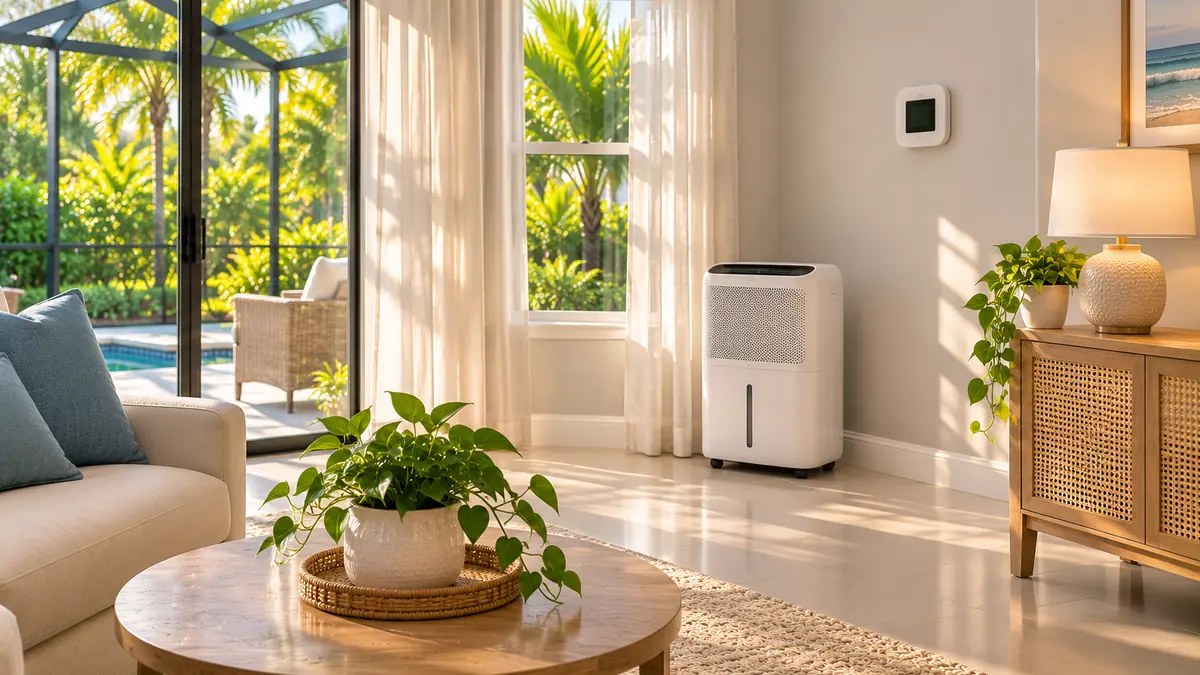
- Add a dehumidifier in rooms that stay damp, such as a closed owner's closet.
- Have the AC drain line and filter maintained on the schedule your HVAC company sets.
Do not turn the AC off to save money while the home is empty. In a humid climate, the savings can cost far more in odors, damaged linens and mattresses, and guest complaints.
Where Mold Starts in a Vacation Home
Mold tends to start in the same places in most vacation homes. Knowing them tells you, and your cleaner, where to look first.
| Spot | Why it gets damp | What to check between stays |
|---|---|---|
| Shower grout and caulk | Water sits after every shower | Dark lines in corners and along the tub |
| AC vents and returns | Condensation where cold air meets humid air | Dark spots on vent covers and nearby ceiling |
| Closets | Doors stay closed, air never moves | Musty smell on stored linens and clothes |
| Under sinks | Slow leaks from drains and supply lines | Swollen cabinet floors, water marks |
| Pool bathroom | Wet swimsuits and towels left behind | Damp towels, standing water on the floor |
| Laundry area | Wet loads forgotten in the washer | Smell inside the washer drum and door seal |
| Sliding door tracks | Rain and pool water collect indoors | Black residue in the track |
The EPA also notes that condensation on windows, walls or pipes can be a sign of high humidity. If you see it inside the home, treat it as a warning about the air, not just a wet surface.
What a Turnover Can Do to Keep Mold Away
Every turnover is a chance to leave the home dry. These are the moisture steps we build into a turnover for Florida homes, alongside the regular cleaning. [VALIDAR]
- Dry wet areas: showers, glass and bathroom floors wiped down
- Bathroom fans run while we work
- Every used towel and bath mat collected, so nothing damp stays behind
- When laundry is part of the plan, linens fully dry before folding and the washer left open
- Doors left open or closed the way you ask, so air can circulate
- A message to you if we notice a musty smell, a leak or dark spots [VALIDAR]
A turnover is a cleaning visit, not an inspection, but the person who cleans every bathroom is often the first to notice a problem. For the full room list, use our vacation rental cleaning checklist. For why linens must be fully dry before they reach the closet, see do Airbnbs wash sheets between guests.
Want turnovers that leave the home dry?
See where the bathroom and laundry steps fit in our vacation rental cleaning in Davenport, from checkout to the ready message.
See How Our Turnovers WorkWhen You See Mold: Call a Licensed Professional
Prevention is the job of the owner and the cleaner. Visible mold growth is a different job, and it belongs to a licensed mold professional.
In Florida, mold remediation is a licensed activity. State law defines it as removing, cleaning or treating mold over more than 10 square feet, in section 468.8411 of the Florida Statutes, part of the chapter that regulates mold-related services.
The EPA's mold cleanup guidance says homeowners can often handle an area smaller than about 10 square feet, and that the water problem must be fixed first or the mold comes back. For anything larger, or any growth after water damage, call a professional.
We are a cleaning company. We do not test, treat or remove mold. If we see what looks like mold growth during a turnover, we tell you, and the next step is a licensed mold assessor or remediator. [VALIDAR: Anne confirmar que avisa o dono quando vê mofo]
Leaks and Water Damage
A leak is the most common reason mold returns after cleaning. Call a plumber for the leak and, if water has soaked floors or walls, a water damage company, before anyone cleans the area.
Long Vacancies, Storms and Owners Abroad
The highest risk is a home that sits empty for weeks. In the Orlando area that often means September and October, which is also the busiest part of hurricane season.
Before a Long Vacancy
- Confirm the AC is on and the humidity reading is in range
- Empty the washer, the dryer and every laundry basket
- Leave interior and closet doors open
- Ask someone to check the home in person at regular intervals
Some owners use a home watch service for those checks: scheduled visits to an empty home to look at the AC, humidity and signs of leaks. Whether we will offer it: [PREENCHER: Anne confirmar se fará home watch].
After a Storm or Power Outage
When the power goes out, the AC stops and humidity climbs inside the home. Once power is back, check that the AC restarted, look for leaks around windows and doors, and air the home out before the next guest arrives.
Owners Who Live Far Away
Many Davenport-area owners live in Brazil or another state and only see the home once or twice a year. A smart thermostat with humidity alerts and a cleaner who reports what they see are the two tools that work from a distance. Read how to manage a vacation rental remotely for the full routine.
A seasonal deep clean for vacation homes in the slow season also removes the build-up humidity leaves behind on grout, vents and baseboards. See when to plan it in our vacation rental deep cleaning schedule. If the home is in a gated community, our resort vacation home cleaning guides cover the gate and HOA side of each visit.
Preventing Mold FAQ
Short answers to what owners ask most about humidity in empty Florida homes. Have a home near Davenport? Request your cleaning quote.