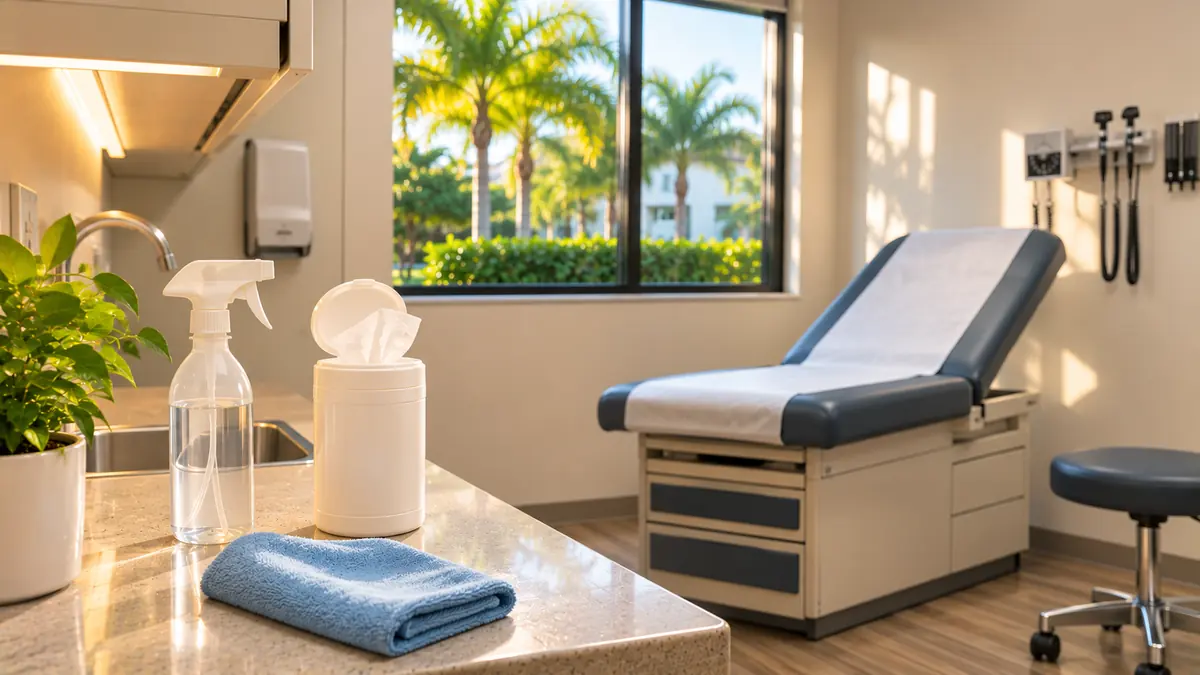
Cleaning vs disinfecting in a medical office comes down to two steps in a fixed order. Cleaning removes dirt and many germs with soap or detergent; disinfecting then uses an EPA-registered product to kill germs left on the surface. The disinfectant only works if the surface stays wet for the contact time on its label.
Key takeaways
- Cleaning removes dirt; disinfecting kills the germs left behind.
- Always clean first, because dirt makes disinfectants work less well.
- Keep the surface visibly wet for the full contact time on the label.
- Sterilizing instruments is a clinical task, not part of cleaning.
Planning the routine for your practice? Start with the medical office cleaning checklist, or jump to disinfectant contact time.
What Cleaning and Disinfecting Each Do
Cleaning vs disinfecting in a medical office is not a choice between two options. They are two separate steps, each with its own job, and a practice needs both on the right surfaces.
Cleaning uses soap or detergent and water to remove dirt, grime and many germs from a surface. Disinfection uses a chemical product to kill the germs that are still there after cleaning. The CDC explains the difference, along with sanitizing, in its guide on when and how to clean and disinfect a facility.
Two more words come up in a practice, and they are easy to mix up. The table puts all four side by side.
| Step | What it does | Where it applies in a practice | Who usually does it |
|---|---|---|---|
| Cleaning | Removes dirt and many germs with soap or detergent | Every surface, floors, sinks, counters | Cleaning team, and staff for spills |
| Sanitizing | Reduces the germs that remain after cleaning | Break room and food areas | Cleaning team |
| Disinfecting | Kills germs left on a cleaned surface | High-touch points, restrooms, patient areas | Cleaning team after hours, clinical staff between patients |
| Sterilizing | Destroys all microbial life on instruments | Medical and dental instruments | Clinical staff only |
Sterilizing is not part of cleaning at all. It belongs to the clinical side of the practice, along with instruments and patient care equipment.
Why You Clean First, Then Disinfect
A disinfectant sprayed on a dirty surface is working against the dirt before it reaches the germs. The CDC notes that impurities like dirt can make it harder for disinfecting chemicals to kill germs, and tells facilities to clean the surface with soap and water first.
Think of a waiting room armrest at the end of a full day. It carries skin oils, hand lotion and dust. If the disinfectant goes straight on, part of it is spent on that layer, and the germs under it can survive.
- Step one, clean: remove visible dirt with detergent and a clean cloth
- Step two, disinfect: apply an EPA-registered disinfectant to the cleaned surface
- Step three, wait: leave it wet for the contact time on the label
Some products are labeled to clean and disinfect in one product. Even then, the label says when that applies, and a visibly dirty surface still needs cleaning before it can be disinfected.
Disinfectant Contact Time: The Step Most Often Skipped
Contact time, sometimes called dwell time, is how long a disinfectant must stay on a surface to do its job. It is printed in the directions for use on the product label, and it differs from one product to the next and from one germ to the next.
The EPA is direct about it: the surface should stay visibly wet for the entire contact time, and if it dries early, more product should be applied. That guidance is on its page about selected EPA-registered disinfectants, which also stresses reading the label before use.
The EPA's List N tool shows how much contact times vary, since it lets you filter products by contact time in minutes. Two bottles on the same shelf can ask for very different waits.
Why Contact Time Fails in Real Life
The most common failure is the spray-and-wipe habit: the product goes on and is wiped dry seconds later. The surface looks clean, but it was only cleaned, not disinfected.
In Florida practices, there is a second cause. Rooms kept cold by strong air conditioning, with a supply vent blowing over a counter, can dry a thin layer of product faster than expected. Watch the surface, not the clock, and reapply if it dries before the time is up. [VALIDAR]
The Two-Step Routine, Surface by Surface
A clear routine makes contact time easy to respect. Working in an empty practice after patient hours helps, because nobody needs the counter while the product sits.
- Read the label: surface compatibility, dilution, contact time and protective gloves.
- Clean each surface with detergent and a fresh microfiber cloth.
- Apply the disinfectant so the surface is visibly wet.
- Move to the next surface while the first one stays wet.
- Come back after the contact time and wipe if the label asks for it.
- Change cloths between areas, and keep restroom cloths apart.
Working in a loop, cleaning one surface while another sits wet, keeps the visit moving without cutting the wait short. For the rooms and tasks this routine applies to, use our medical office cleaning checklist.
Rather have both steps handled after hours?
We offer cleaning for clinics and dental offices after patient hours. Which surfaces get disinfected, and with which product, is agreed with your practice at the walkthrough and written into the checklist. VALIDAR
Request a Medical Office WalkthroughWhich Surfaces Need Cleaning Only and Which Need Both
Not every surface in a practice needs a disinfectant on every visit. The CDC's dental guidance on environmental surfaces separates clinical contact surfaces, touched during care, from housekeeping surfaces such as floors, walls and sinks.
| Surface | Cleaning | Disinfecting | Who does it |
|---|---|---|---|
| Floors and walls | Every visit | After a blood or body fluid spill | Cleaning team cleans; clinical staff handle spills |
| Door handles and switches | Every visit | Every visit | Cleaning team |
| Waiting room armrests and check-in counter | Every visit | Every visit | Cleaning team |
| Restroom toilets, faucets and handles | Every visit | Every visit | Cleaning team |
| Clinical contact surfaces | Between patients | Between patients | Clinical staff |
The CDC's broader Guidelines for Environmental Infection Control in Health-Care Facilities cover environmental cleaning in healthcare settings in more depth. Your practice decides which products and frequencies apply to its rooms.
The waiting room and front desk share many touch points with any office, from door handles to card terminals. Our guide to office high touch surfaces lists them with a frequency for each.
Common Disinfecting Mistakes in Small Practices
Most problems come from habits, not from the wrong product. These are the ones worth checking in any practice.
- Spraying and wiping right away, before the contact time is reached
- Disinfecting a surface that was never cleaned
- Using one cloth for the restroom and the front desk
- Mixing products, which can release dangerous fumes
- Using a product on a surface its label does not list
- Keeping a diluted solution for days instead of mixing it fresh as directed
The CDC's dental guidance says cleaning and disinfecting solutions should be prepared fresh daily, following the manufacturer's directions. A bottle mixed last week may not do what its label promises.
What the Practice Owns and What the Cleaning Team Owns
The practice sets the infection control rules; a cleaning team follows them in the rooms it is hired to clean. Keeping that line clear protects everyone.
Under the OSHA bloodborne pathogens standard, employers keep a written schedule for cleaning and decontamination and make sure contaminated work surfaces are decontaminated after procedures and after spills. That is a duty of the practice and its trained staff.
Gatehouse Clean does not clean up blood or body fluid spills and does not handle regulated medical waste, sharps or instruments. These stay with your clinical team and licensed waste hauler. [VALIDAR]
Before hiring anyone, ask how they handle products, labels and contact time, along with scope and insurance. Our list of questions to ask a commercial cleaning company before hiring helps you cover it. To plan how often each step happens, read how often to clean a medical or dental office.
Cleaning vs Disinfecting FAQ
Short answers to what practice managers ask most about cleaning, disinfecting and contact time.